


Washington ADU Law
HB 1337, in plain English.
The 2023 Washington state law that rewrote ADU rules in Seattle, Bellevue, Kirkland, Redmond, Mercer Island, Sammamish, Issaquah, and Newcastle. What it changed, where it applies, and what your lot now allows.
Written by Aharon Elisha, founder of MNBE Construction & Development. WA license MNBECCD770R9. Updated 2026.
What HB 1337 actually is.
HB 1337 is a Washington state law passed during the 2023 legislative session and signed by the Governor in May 2023. It removes local government barriers to building Accessory Dwelling Units across the state. The enforceable text lives in RCW 36.70A.681, a section of the Growth Management Act that binds every city of 25,000 people or more.
It is a preemption statute. The state legislature explicitly overrode any conflicting city or county code. Before HB 1337, ADU rules were almost entirely local. After HB 1337, the floor is the same statewide. A city can be more permissive. No city can be more restrictive than the statutory minimums on the items the law covers.
Six things HB 1337 changed for every Seattle area homeowner.
These are the provisions that most often turn an unbuildable lot into a buildable one. Each one used to be a local code question. Now they are state mandates.
Two ADUs per residential lot
Cities of 25,000 or more must permit at least two ADUs on every lot zoned for a single family home, in any combination of detached, attached, or basement. Many Eastside cities previously capped lots at one ADU. That cap is gone.
Owner occupancy banned
Cities can no longer require the owner of the primary home to live on the property. You can build an ADU on a pure rental property, build to sell, or rent both units.
Parking minimums eliminated near transit
No off street parking can be required for an ADU within half a mile of a major transit stop. Most Seattle and central Eastside residential zones now sit inside that radius.
Setback floors capped
Cities cannot require ADU setbacks larger than the standard for primary homes in that zone. The old extra five feet for an ADU rule is no longer enforceable.
Lot size minimums capped
If your lot meets the minimum size for a primary home in your zone, it meets the minimum to add an ADU. Cities cannot impose stricter ADU-specific lot minimums.
Sale of ADUs as condos allowed
HB 1337 enables condominium-style sale of ADUs in some cases, opening a new path for homeowners to monetize a backyard cottage as a separate parcel of ownership.
How HB 1337 lands in each Seattle and Eastside city.
The state floor is the same everywhere. Local execution is not. Practical compliance status in the cities MNBE works in most often.
| City | 2 ADUs allowed | Parking required | Owner occupancy | Notes |
|---|---|---|---|---|
| Seattle | Yes | 0 (most zones, transit served) | Banned | Pre-approved DADU program available. SDCI compliance updated 2024. |
| Bellevue | Yes | 0 within ½ mi transit | Banned | Code updated 2024. Design review still applies in some neighborhood overlays. |
| Kirkland | Yes | 0 within ½ mi transit | Banned | Among the fastest Eastside permit timelines for ADU work. |
| Redmond | Yes | 0 within ½ mi transit | Banned | ADU and DADU permits commonly issue in 8 to 14 weeks after submittal. |
| Mercer Island | Yes (was 1) | 1 (off-transit) | Banned (was required) | Critical-area review tightly enforced. Expect a CAR study on most lots. |
| Sammamish | Yes | 0 within ½ mi transit | Banned | Lower DADU volume than central Eastside. Permitting straightforward. |
| Issaquah | Yes | 0 within ½ mi transit | Banned | Older HOA covenants common. Covenant review part of feasibility. |
| Newcastle | Yes | 1 (most lots) | Banned | Hillside lots common. Engineering scope drives more of the budget than zoning. |
Note · Compliance status as of 2026. Codes change. Verify with a feasibility study before commissioning design.
What HB 1337 does not change.
Building code. HB 1337 is a zoning law, not a building code amendment. The Washington State Energy Code, fire code, plumbing and mechanical codes, and the International Residential Code all still apply in full. ADUs must meet the same construction standards as any habitable structure.
Critical area ordinances. Steep slopes, wetlands, streams, fish and wildlife habitat, and geologically hazardous areas are governed by each city's critical area code under the Growth Management Act. If your lot triggers critical area review, that review still happens.
Height and lot coverage caps. Cities can still enforce reasonable maximum heights and total lot coverage percentages. Most Seattle and Eastside zones cap ADU height at 18 to 25 feet and total lot coverage at 35 to 45 percent.
Design review (sometimes). Some cities run design review boards for projects in landmark districts or specific neighborhood overlays. HB 1337 forbids treating ADUs more harshly than primary homes in design review, but it does not abolish design review itself.
Utility capacity. Water, sewer, and stormwater connections still must meet city engineering standards. Adding a second dwelling unit can trigger a sewer capacity charge or a stormwater management requirement that has nothing to do with zoning.
What HB 1337 means for your specific lot.
In Seattle, Bellevue, Kirkland, Redmond, and Mercer Island, every residential lot now allows at least two ADUs. Your buildable footprint is determined by setbacks, height, and lot coverage, not by an ADU specific rule. Most central lots support a 1,000 to 1,200 sq ft DADU with no required parking spaces.
HOA covenants drafted before 2023 often contain blanket ADU bans. Many of those bans are now partially unenforceable under amended RCW 64.38. Reasonable design rules survive. Outright prohibitions usually do not. Covenant review is part of our feasibility study.
Steep slopes, wetland buffers, and tree retention still apply. HB 1337 did not touch them. Critical area constraints are usually workable with a critical area study and intentional siting, and we coordinate that work directly when needed.
"HB 1337 is the most important Washington housing law in a generation. Half the lots we feasibility-checked in 2024 became buildable overnight because of this bill. Read the chapters above. Then call us. We will tell you in writing what your specific lot allows."
Aharon Elisha · Founder, MNBE Construction & Development
Keep Reading
The decisions HB 1337 unlocks.
DADU
Detached ADUs
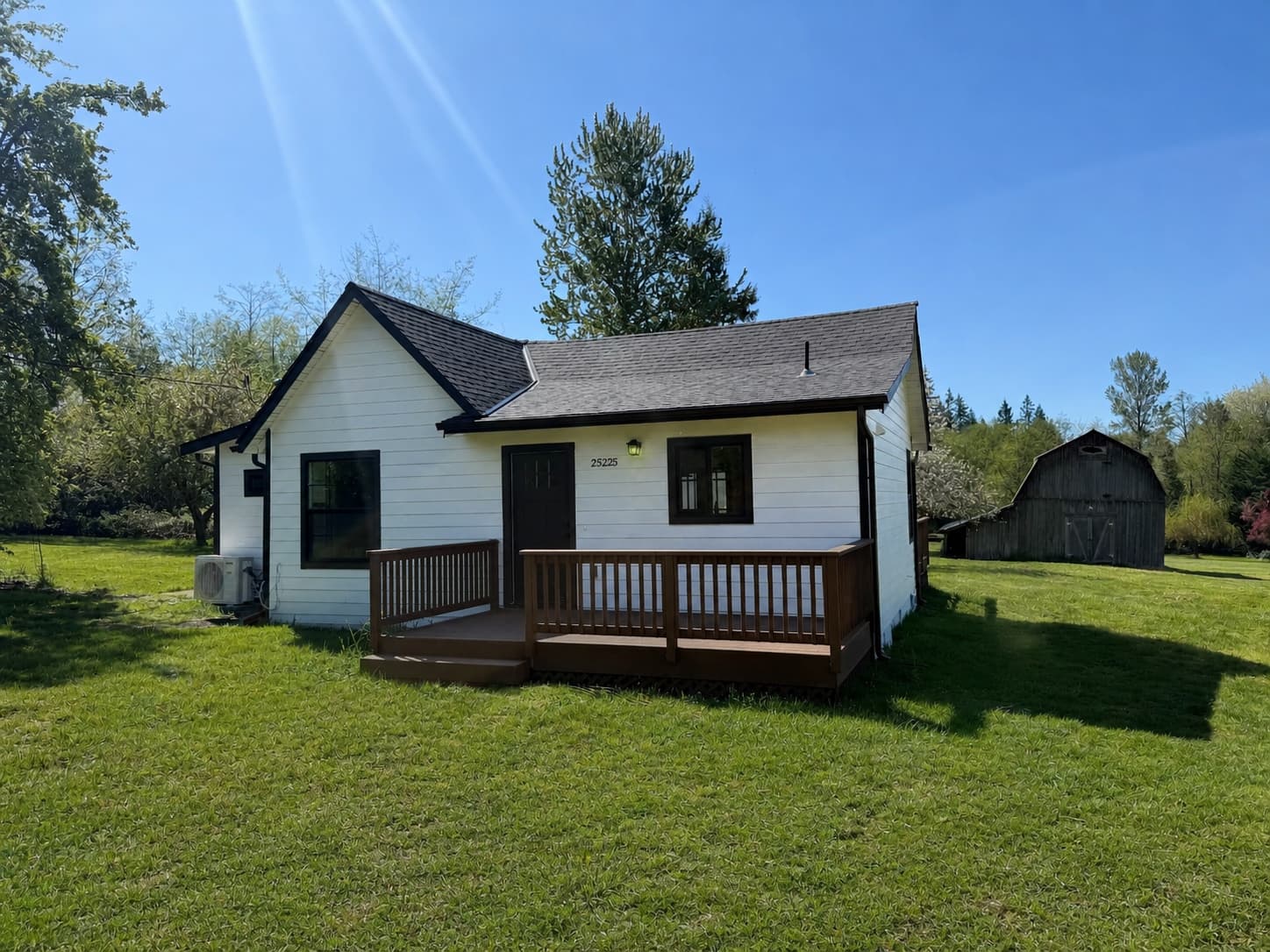
The dominant ADU type now that HB 1337 unlocked the lots. Cost, timeline, and rental income.
Read the DADU guide →AADU
Attached ADU (AADU)
When attached beats detached on cost, lot fit, or schedule. HB 1337 enables both.
Compare AADU vs DADU →
Step One
Feasibility Studies
The 1 to 2 week written analysis that confirms whether HB 1337 makes your specific lot buildable.
See feasibility →Frequently Asked
HB 1337 questions Seattle homeowners ask before they call us.
The legal text is dense. The practical answers are not. If yours is not here, call us. Two minutes on the phone usually clears it up.
Still have questions?
We answer the phone Monday through Saturday. Two minutes on the call usually gets you further than an hour online.
HB 1337 is a Washington state law passed in 2023, codified as RCW 36.70A.681, that overrides local city zoning to expand where and how Accessory Dwelling Units can be built. In cities of 25,000 people or more, every residential lot must allow at least two ADUs. Owner occupancy of the primary home cannot be required. Parking minimums for ADUs near transit are eliminated. Minimum lot size rules for ADUs are capped. The practical effect is that thousands of Seattle and Eastside lots that were unbuildable under prior city codes are now permittable.
HB 1337 was signed into law in May 2023. Cities had until July 1, 2025 (or six months after their next required Comprehensive Plan update, whichever was later) to bring their local zoning into compliance. Seattle, Bellevue, Kirkland, Redmond, Mercer Island, Sammamish, and Issaquah have all updated their codes. Cities that missed the deadline must apply the state default rules directly until they update. HB 1337 is enforceable today regardless of whether your city's books have caught up.
If your lot is zoned for residential use and sits in a city or unincorporated area inside an Urban Growth Area of a county that includes a city of 25,000 people or more, HB 1337 applies. That covers virtually all of King County, most of Snohomish County, and the urbanized parts of Pierce County. The law does not apply on lots in pure rural residential or resource land zoning, on tribal land, or in cities under 25,000 with no neighboring qualifying jurisdiction.
Yes, in nearly every Seattle and Eastside city. HB 1337 mandates that cities allow at least two ADUs per residential lot, in any combination: one detached plus one attached, two detached, basement plus detached, and so on. Some cities (Seattle, Bellevue) had already allowed two ADUs before the law passed. Others (Mercer Island, Issaquah) had to expand from one. Total floor area, height, and lot coverage caps still apply, so two ADUs is the legal allowance, not always a buildable allowance. Your lot's specific dimensions determine what fits.
Largely yes, with a transit nuance. Cities subject to HB 1337 cannot require off street parking for an ADU located within one half mile of a major transit stop. For ADUs farther from transit, cities can require at most one off street parking space per ADU, and only if the requirement is justified. Most of Seattle, Bellevue, Kirkland, and Redmond's residential zones fall within transit walking distance, so the practical answer for the majority of MNBE projects is zero required parking spaces.
Often yes, with caveats. RCW 64.38, the WA Common Interest Communities Act, was amended alongside HB 1337 to limit how HOAs can restrict ADUs. Most HOA covenants drafted before 2023 are now partially unenforceable against ADU construction, particularly if the covenant tries to ban ADUs outright in violation of state policy. HOAs can still enforce reasonable design and material standards. We have handled covenant analysis on Eastside HOA properties.
No. HB 1337 expanded zoning rights, not environmental rules. Critical area review (steep slopes, wetlands, streams, geologically hazardous areas, fish and wildlife habitat) still applies under Washington's Growth Management Act and each city's critical area ordinance. If your lot has critical area constraints, the right path is a critical area study before design. We coordinate that work directly when the lot calls for it.
The bill text is published by the Washington State Legislature at app.leg.wa.gov under bill 1337 of the 2023 regular session. The codified version is RCW 36.70A.681. Each Eastside city also publishes a compliance summary in its zoning code. For Seattle, the relevant chapters are SMC 23.42, 23.44, and 23.45. We can pull the specific text that applies to your jurisdiction during the consultation if you would like to read it line by line.
Start Your Build
Tell us about your project.
Contact information
Thank you for considering MNBE for your project. We'll get back to you during normal business hours, Monday through Saturday.